

Packet interface: a layered way for devices to talk to each other


ESPHome 2026.12 adds two components for sending data directly between devices. The packet interface component moves packets of bytes over a channel, through a stack of layers that each do one job. The entity transport component uses a packet interface to send sensor and binary sensor states from one device to another.
Where This Came From
Section titled “Where This Came From”Packet transport was added so that ESPHome devices could send sensor states to each other without Home Assistant or an MQTT broker in between. It works, and it is used over Wi-Fi, ESP-NOW, serial ports and LoRa radios. Real use over those channels also showed its limits:
- Each data packet includes the ID of every entity it reports, so packets are large. On a LoRa radio at a high spreading factor, a large packet can take seconds to send.
- A lost packet is not sent again. Its states arrive only with the next update.
- Encryption, the rolling code and the ping-pong check are part of packet transport itself, so no other component can use them.
- Each channel needs its own packet transport platform, which repeats the same work for every channel.
Fixing these one at a time inside packet transport would have made one large component larger. So the job was split into parts instead, based on what packet transport had shown about each part.
The opportunity was also taken to improve the encryption layer, providing a choice of levels of security against replay and spoofing attacks, and closing a denial-of-service loophole.
Links and Layers
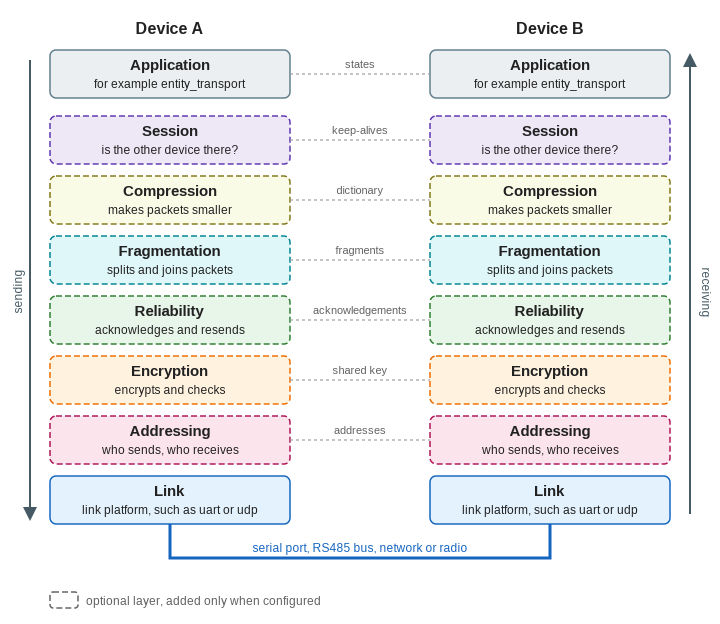
Section titled “Links and Layers”A packet interface has a link at the bottom, which sends packets over one kind of channel. The links available are UART, UDP, TCP, ESP-NOW, and the SX126x and SX127x radios.
Above the link, each layer is optional and does one job:
- addressing: lets several devices share one channel, with a 16-bit address for each device.
- encryption: encrypts each packet with a shared key, with an optional rolling code so a recorded packet sent again is dropped.
- reliability: acknowledges packets, and sends again those that are lost.
- fragmentation: splits a packet that is too large for the channel, and joins it again on the other device.
- compression: makes packets smaller before they are sent, with a dictionary of text that both devices hold.
- session: sends keep-alives, and tells the components above when the other device can be reached.
Layers are always stacked in the same order, whatever order they are written in. A layer knows only about the layers next to it, so a layer can be added or left out without a change to the others. A link can also do a layer’s job itself: TCP already resends what is lost, so a TCP link does not need the reliability layer.
Extensibility
Section titled “Extensibility”Each kind of layer has a type option, and each type is registered under its name. So a different encryption
cipher could be added as a new type. A new reliability method could be implemented that suits certain transports.
These can be provided as external components,
and used in place of the built-in one with the rest of the
stack unchanged. New transport links can be added without re-implementing any of the other layers.
New kinds of layers can also be added if a need becomes apparent.
Entity Transport
Section titled “Entity Transport”Entity transport does the job of packet transport on top of a packet interface. It sends a dictionary of entity IDs at boot and when the other device needs it. Each state is then sent with a number in place of the ID, so its packets are small. Encryption, resends and the connection status come from the layers, not from entity transport.
One device sends the state of a sensor over a serial port:
uart:  tx_pin: GPIOXX  rx_pin: GPIOXX  baud_rate: 115200
packet_interface:  - platform: uart    id: serial_link    encryption: !secret serial_link_key    reliability:    session:
entity_transport:  - packet_interface: serial_link    sensors:      - outdoor_temperature
The other device, with the same uart and packet_interface configuration, shows that state as its own sensor:
sensor: - platform: entity_transport provider: garden-node remote_id: outdoor_temperature name: Outdoor temperatureWith a reliability layer and a session layer, entity transport sends a state when it changes, and sends all states again at boot and each time the other device can be reached again. Without them, it also sends all states at an interval, so that a lost packet is soon made good.
Extensively Tested
Section titled “Extensively Tested”Extensive bench testing has been done on all the links and layers, and in addition it has been used in a significant real-world application using LoRa as the link, with multiple devices communicating over both plain-text broadcast, and encrypted point-to-point links, over distances up to 15km.
Packet Transport Is Still There
Section titled “Packet Transport Is Still There”Packet transport is not removed, and existing configurations do not change. Packet transport can also use any packet interface as its channel, through its new packet_interface platform, so an existing setup can gain resends or fragmentation without a change to its sensors.
Entity transport and packet transport do not understand each other’s packets, so both devices must use the same one. See the packet interface and entity transport pages for the full options.