

Vevor DTX Weather Station
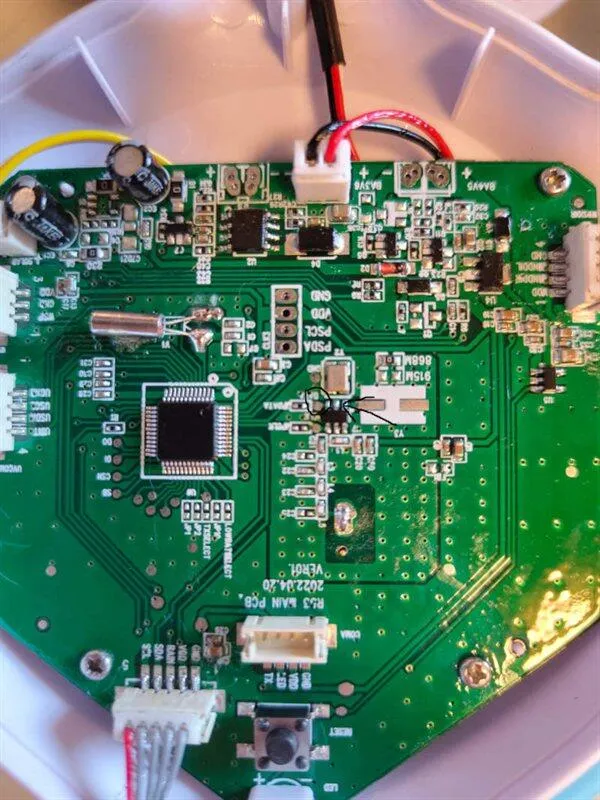
The vevor_dtx component decodes the internal DTX data signal used by some Vevor 7-in-1 weather station
receiver displays. It is intended for installations where an ESP is connected to the receiver board data signal,
rather than receiving the outdoor sensor’s RF transmission directly.
The signal is captured by a Remote Receiver, so the pin can be shared with other
remote protocols and the ESP32 uses its RMT hardware for the capture. The hub decodes each frame and publishes
the readings through its sensor, text_sensor and binary_sensor platforms.
Component/Hub
Section titled “Component/Hub”# Example configuration entryremote_receiver: id: rcvr pin: GPIOXX filter: 20us idle: 3ms
vevor_dtx: receiver_id: rcvrConfiguration Variables
Section titled “Configuration Variables”- receiver_id (Optional, ID): The ID of the Remote Receiver connected to the DTX signal. Required when more than one receiver is configured.
- station_id (Optional, int): Only decode frames from the outdoor station with this ID, so a neighbour’s
station cannot overwrite the readings. Read the ID of your station from the
sensor_idtext sensor first, then set it here, for examplestation_id: 0x1234. Defaults to accepting every station. - bit_time (Optional, Time): Expected DTX bit timing. Defaults to
88us.
The receiver’s filter must stay below the bit time, and its idle sets the gap that ends a frame; the values
above work with the default bit time.
Sensor
Section titled “Sensor”sensor: - platform: vevor_dtx temperature: name: Outdoor Temperature humidity: name: Outdoor Humidity wind_speed: name: Wind Speed wind_gust: name: Wind Gust wind_direction_degrees: name: Wind Direction rain: name: Rain uv_index: name: UV Index illuminance: name: Illuminance tx_counter: name: TX CounterConfiguration Variables
Section titled “Configuration Variables”- vevor_dtx_id (Optional, ID): The ID of the
vevor_dtxhub. Required when more than one hub is configured. - temperature (Optional): Outdoor temperature in degrees Celsius. All options from Sensor.
- humidity (Optional): Outdoor relative humidity. All options from Sensor.
- wind_speed (Optional): Wind speed in meters per second. All options from Sensor.
- wind_gust (Optional): Wind gust speed in meters per second. All options from Sensor.
- wind_direction_degrees (Optional): Wind direction in degrees. All options from Sensor.
- rain (Optional): Rain in millimeters as a running total since the station was powered up; it is published
with the
total_increasingstate class. All options from Sensor. - uv_index (Optional): UV index. All options from Sensor.
- illuminance (Optional): Illuminance in lux. All options from Sensor.
- tx_counter (Optional): The station’s transmission counter, a diagnostic value that counts from 0 to 255 and wraps. All options from Sensor.
Text Sensor
Section titled “Text Sensor”text_sensor: - platform: vevor_dtx sensor_id: name: Vevor Sensor IDConfiguration Variables
Section titled “Configuration Variables”- vevor_dtx_id (Optional, ID): The ID of the
vevor_dtxhub. Required when more than one hub is configured. - sensor_id (Optional): Outdoor station identifier as a hexadecimal string. All options from Text Sensor.
Binary Sensor
Section titled “Binary Sensor”binary_sensor: - platform: vevor_dtx low_battery: name: Vevor Low BatteryConfiguration Variables
Section titled “Configuration Variables”- vevor_dtx_id (Optional, ID): The ID of the
vevor_dtxhub. Required when more than one hub is configured. - low_battery (Optional): Outdoor station low battery flag. All options from Binary Sensor.
Hardware Notes
Section titled “Hardware Notes”The DTX signal is a logic-level signal on the Vevor receiver board. Connect the ESP ground to the receiver board
ground and connect the DTX signal to the remote receiver’s GPIO. A series resistor, for example 47 kOhm to
100 kOhm, is recommended between the receiver board and the ESP input.
CAUTION
Confirm that the signal presented to the ESP GPIO is 3.3V logic level. Do not connect a 5V signal directly to an ESP input.
On ESP8266 boards, use a GPIO that supports interrupts. GPIO14 is a common choice on ESP8266 modules such as the
ESP-WROOM-02. Avoid GPIO16, boot strap pins, and UART pins unless your board design specifically accounts for them.